For the better part of two decades, my job description was some version of "teach children to grow food." I spent eighteen years at the Edible Schoolyard Project, then a stretch at an international school in Thailand, then led a national education nonprofit called Maker Ed. I used to think of that as the soft and charming part of my resume, the part that people thought sounded interesting but had no real way to engage in it. I have come to believe it was the most rigorous training I ever received.
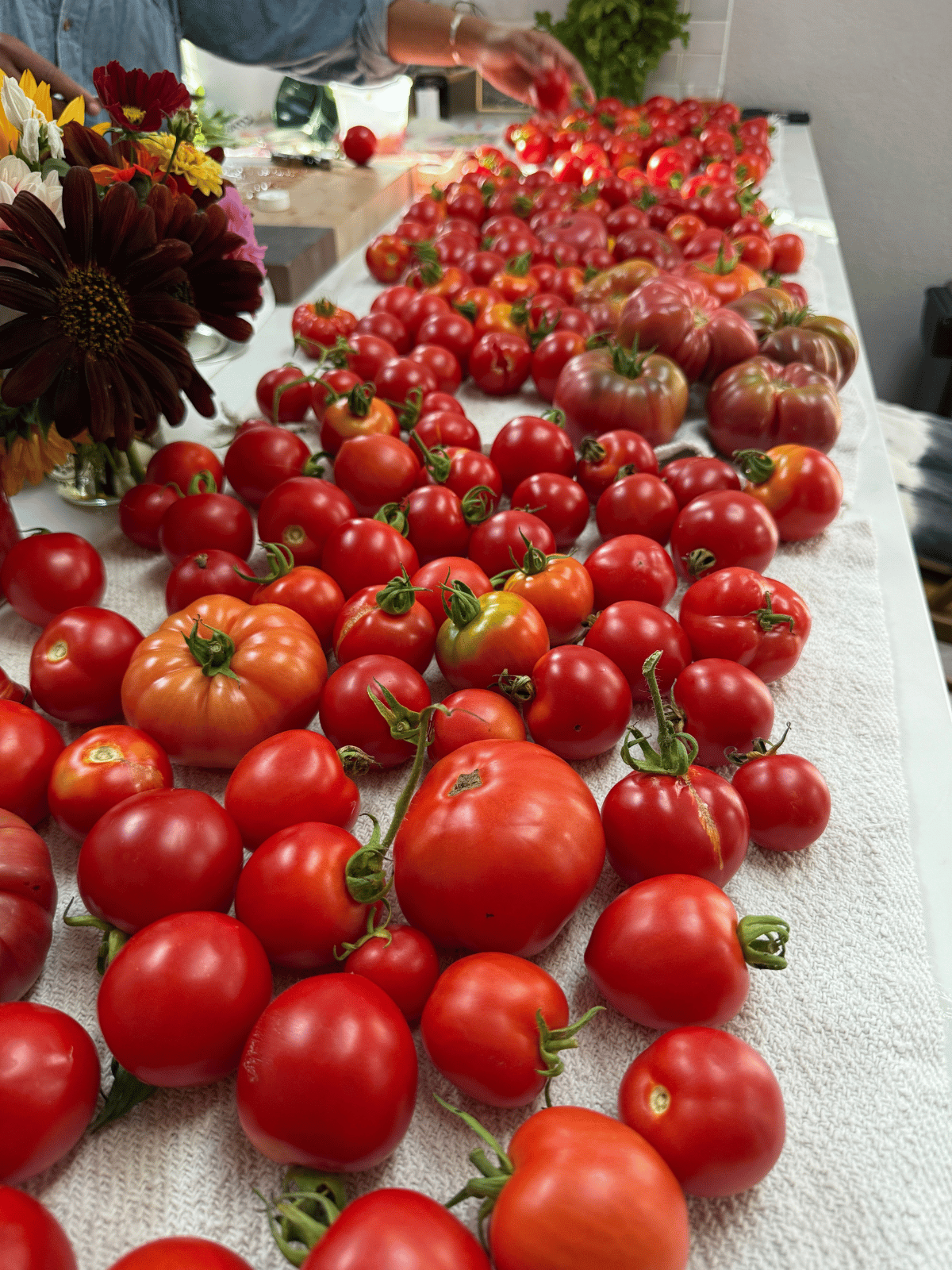
When you tend land, all of your assumptions become tangible at some point. You don’t get to stay in your own head. You are either right or wrong, and things never stay in the abstract. What grows depends on soil and water and timing and climate and what you were actually trying to produce, and you only get one growing season a year to test any of it. You make a change, you wait, you observe what happened, and you are forced to sit with the gap between what you intended and what occurred, which are almost never the same thing. The tomatoes do not care about your theory of change. You cannot speed up the feedback loop by working harder or by writing a better strategy document. There is only attention, patience, experimentation, and a willingness to change course when the evidence disagrees with your plan. A garden was the first place I understood that the things worth building are the things built to last, and that lasting is not an accident. It is designed, season over season, by someone paying close attention.
I am now the Chief of Staff at The Just Trust, where we work to transform the criminal justice system. Most days, my job is leading the work that determines whether an institution's stated values actually show up in how it operates: strategy, governance, people systems, the parts of an organization that rarely make it into a mission statement but quietly decide whether the mission is actually being achieved. In practice, that means asking whether the way we make decisions, allocate resources, structure teams, and measure success actually reflects the future we say we are trying to build.
Two convictions shape how we try to do that, at The Just Trust and in the work I did long before it. The first is that rigor and care are not opposites. We tend to treat them as a dial, where turning up one turns the other down, and that view is both wrong and expensive. Care is better understood as a design constraint, a requirement built into the system so that it produces excellent work without using up the people who produce it. Like any real constraint, it makes the design harder and the result better. The second is that the hardest problems inside an organization are almost never technical. They are problems of clarity: whether we can actually say how our work happens, who decides what, and what we mean when we call something good.
That question of clarity feels especially urgent now, as organizations rush to adopt artificial intelligence (AI) and other technologies that promise to transform how we work. What AI is doing to organizations interests me so much because it is not mainly what people expect. In practice it behaves less like a productivity engine than like an unusually honest diagnostic. The moment you try to hand a piece of work to a machine, you have to describe that work precisely, and most organizations discover in that instant how much of what they do has never been written down, agreed upon, or examined. What AI exposes first is rarely a technology gap. It is the accumulated ambiguity that a few experienced people have been quietly absorbing for years.

Gardening taught me to think in seasons. Institutional work asks us to think in generations. We are, as a country, spending these years arguing about what our first two and a half centuries meant and what the next 250 should hold. Most of that argument plays out at a scale none of us controls. Work does not. Work is one of the few systems shaping people's daily lives that we can actually redesign, at the scale of a single organization, without waiting for legislation or anyone's permission. That is an enormous amount of leverage over the kind of country we are slowly building, and it is mostly wasted.
AI is about to make that leverage sharper in both directions. Used well, this moment is a chance to get specific about how our institutions really work, what they truly value, what they should never hand to a machine, and how to build the kind of durability that holds for a very long time. Used carelessly, it is a way to make our present confusion permanent and much harder to see. Which of those we choose is not, in the end, a technology question. It is the oldest question I know, the one the garden asks me every day: What care and attention am I giving to the resources I have to ensure I am building something that will outlast me?
A school garden and the American justice system could not look more different, but building anything meant to last requires the same things: clarity about what you are trying to produce, attention to what is actually happening, and a willingness to change when reality stands at odds with your plans. I realize now there has only ever been one question. How do you build something that endures, does what it says it will do, and treats the people inside it as the most important resource rather than fuel to burn through? At The Just Trust, we are asking it of the justice system, which may be the highest-stakes version of the question in American life. Answering it will take institutions that are demanding and deeply human, rigorous enough to be trusted and caring enough to be worth trusting. That is the work I came here to do, and it is not work any of us finishes alone.